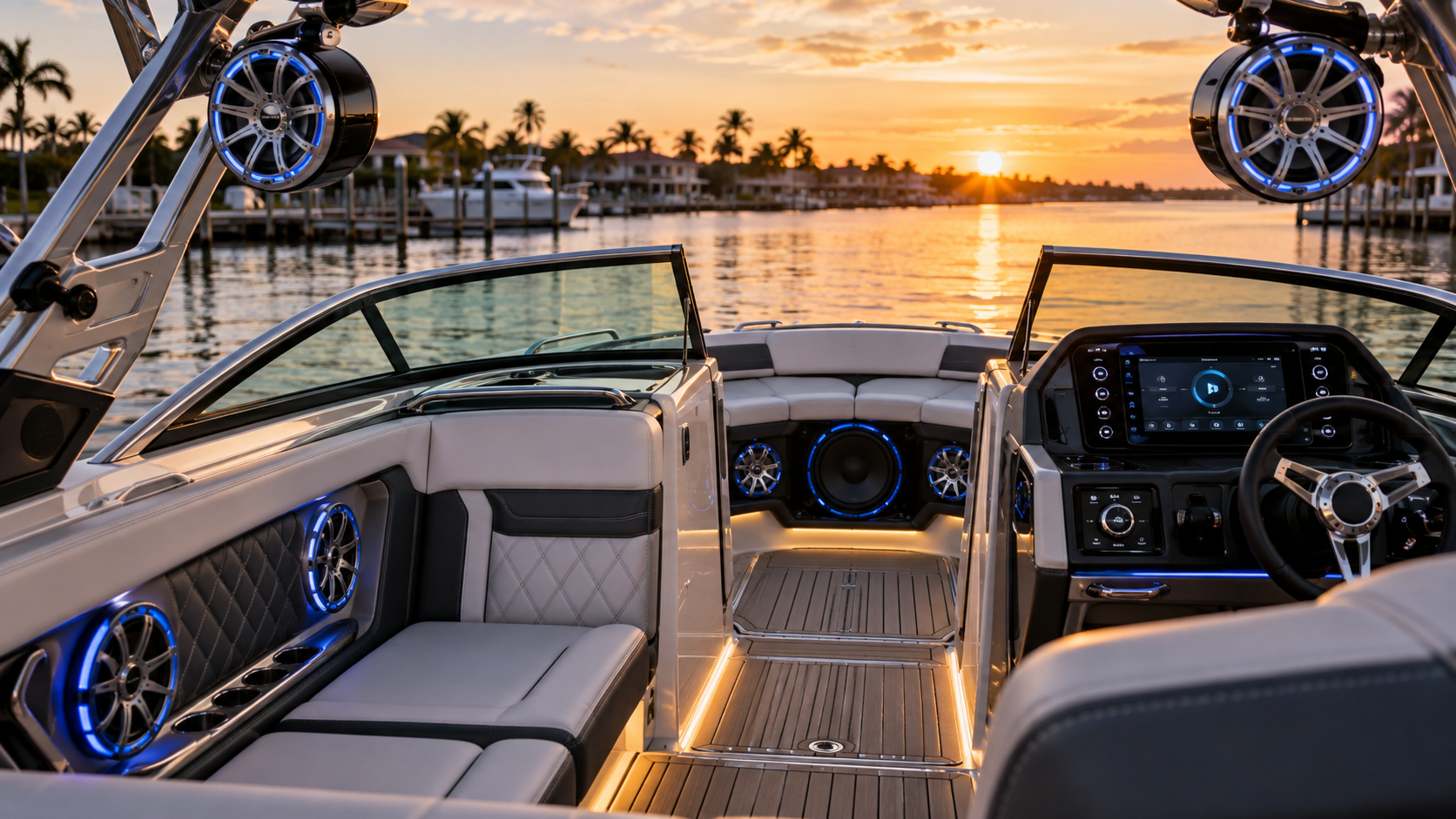
There are few places where a good sound system gets used quite like it does on a boat.
Whether you’re cruising across a lake, fishing offshore, anchored at a sandbar or spending the afternoon with friends, music becomes part of the experience. Unfortunately, many factory boat audio systems leave a lot to be desired—and simply turning the volume up doesn’t necessarily make them sound better.
Wind, engines, waves and an open-air environment create challenges that don’t exist inside a car. Add water, humidity, salt and constant sun exposure, and boat audio equipment has an especially difficult job.
The good news is that you don’t necessarily need to replace everything at once.
Here are some of the boat audio upgrades that can make the biggest difference.
1. Upgrade Your Marine Speakers
This is often the most obvious place to start.
Older factory speakers can become faded, distorted or simply too quiet to overcome wind and engine noise. Replacing them with quality marine-grade speakers can improve clarity and allow the system to play louder without sounding harsh.
The important word here is marine-grade.
Boat speakers have to deal with conditions ordinary automotive speakers weren’t designed for, including moisture, UV exposure, temperature changes, vibration and—in coastal areas—salt. Marine audio installers typically use components designed specifically to withstand those conditions.
Depending on the boat, you may also be able to add speakers in locations where none existed originally.
That can make a huge difference on larger boats where passengers may be spread between the bow, cockpit, swim platform and other areas.
2. Add an Amplifier
New speakers can sound better with the factory system, but an amplifier can help them reach their full potential.
A properly matched marine amplifier gives speakers the power they need to stay clear at higher volume levels—something that matters when you’re trying to hear music over wind, water and an engine.
Amplifiers can also provide the additional power needed if you’re adding more speakers or a subwoofer.
As with the speakers themselves, the amplifier should be intended for marine use. Water resistance, corrosion resistance and protection from the marine environment matter just as much as wattage.
3. Add a Marine Subwoofer
Do you need a subwoofer on a boat?
No.
Will you notice it if you add one?
Absolutely.
Regular speakers aren’t particularly good at reproducing the lowest bass frequencies. A subwoofer takes over that job, allowing the rest of the speakers to concentrate on mids and highs.
The result isn’t simply “more bass.” A properly designed system can sound fuller and more balanced overall.
Marine subwoofers are available in configurations that work well even when enclosure space is limited. Some are designed for infinite-baffle installations, allowing them to be mounted without a traditional enclosed subwoofer box.
4. Replace the Head Unit
An older radio can hold back an otherwise good system.
Newer marine receivers can add features such as:
- Bluetooth music streaming
- USB connectivity
- Smartphone control
- SiriusXM compatibility
- Multiple audio zones
- Remote controls at different areas of the boat
Multi-zone control is especially useful on larger boats.
Imagine having one volume level at the helm, another in the bow and another near the swim platform instead of forcing every passenger to listen at the same volume.
That’s not hypothetical. Kansas City installer Santa Fe Auto Sound has documented a Chaparral 276 SSX project that used separate controls for the bow, cockpit, swim platform and subwoofers.
5. Create Multiple Audio Zones
This may be one of the most underrated upgrades for larger boats.
A single-volume system works reasonably well on a small boat. It can become frustrating on a larger bowrider, cruiser or pontoon.
Someone sitting near a speaker may think the music is too loud while passengers in another part of the boat can barely hear it.
Zone control solves that problem.
A professionally designed system can divide speakers into different areas and allow those areas to be adjusted independently.
For boaters who regularly entertain, anchor with friends or spend time swimming behind the boat, this can be a much more useful upgrade than simply adding more speakers.
6. Add Tower or Rear-Facing Speakers
Wake boats and other recreational boats create another challenge: sometimes you want the music to reach people who aren’t actually inside the boat.
Tower speakers can project sound farther than standard cockpit speakers.
Depending on the boat and how it’s used, installers can also create rear-facing speaker systems for swimming, wakeboarding or hanging out behind the boat.
Placement matters here. More speakers aren’t automatically better. The direction of the speakers, available amplifier power and where passengers spend their time should all be considered when designing the system.
7. Add LED Speaker and Accent Lighting
This doesn’t technically make the boat sound better.
It can make it look considerably better.
Many marine speakers and subwoofers are now available with integrated RGB lighting. Additional LED accent lighting can be installed around seating, storage compartments, decks or other areas of the boat.
Some marine specialists combine audio and lighting into a single custom installation so the two systems look intentional instead of like separate aftermarket additions.
Don’t Overlook the Wiring
Here’s the least exciting upgrade on this list—and one of the most important.
Wiring.
A boat is not the place for questionable electrical connections.
Marine installations need to account for moisture, corrosion, vibration and the electrical demands being placed on the boat’s charging and battery system.
For a large audio upgrade, an installer may recommend upgrading wiring, improving power distribution or even adding another battery.
The goal isn’t just louder music.
It’s creating a system that performs correctly without compromising the reliability of the rest of the boat.
Can You Upgrade Boat Audio Yourself?
Some upgrades can absolutely be DIY projects, particularly replacing speakers or swapping a simple head unit if you’re comfortable with 12-volt wiring.
Larger installations are different.
Adding amplifiers, subwoofers, multiple zones, custom speaker locations, additional batteries and lighting can quickly become more complicated.
A professional marine-audio installer can help determine:
- Which equipment fits your boat
- Where speakers should be positioned
- How much amplifier power is needed
- Where amplifiers and other electronics should be mounted
- Whether the electrical system can support the upgrade
- How wiring should be routed and protected
- How the completed system should be tuned
If you’re planning to invest several thousand dollars in equipment, paying attention to the installation can be just as important as choosing the equipment itself.
Where Can You Get Boat Audio Upgraded?
Boat audio specialists aren’t found on every corner, and the right shop may depend on where you live and what kind of project you’re planning.
The following aren’t intended as a ranking. They’re examples of established shops around the country that specifically advertise marine-audio installation and related boat-electronics services.
North: Minnesota
With more than 10,000 lakes, Minnesota is an obvious place to find companies that know their way around boat audio.
Marine Audio MN specializes specifically in marine audio and works on boats ranging from smaller fishing boats to large yachts. The company offers marine speakers, amplifiers, subwoofers, lighting and custom installations and can perform some installations at a customer’s home or slip.
Another Twin Cities-area option is Mobile Installation Service in Brooklyn Park. In addition to automotive work, the company installs marine speakers, subwoofers, amplifiers, head units, lighting and custom marine-audio components.
South: Pensacola & the Florida Gulf Coast
Saltwater creates an especially demanding environment for audio equipment, making proper components and installation particularly important along the Gulf Coast.
Quality Car Stereo in Pensacola has worked with boat audio for decades and expanded into full marine-electronics sales and installation. The shop also works with navigation and marine-electronics brands in addition to audio equipment.
Pensacola boat owners can also look at Revolutions Marine, a broader marine-service company that installs complete marine-audio systems including head units, speakers, amplifiers, subwoofers and custom wiring.
For coastal boat owners, choosing a shop familiar with saltwater installations can be particularly valuable because corrosion protection and proper wiring become part of the project—not an afterthought.
East: North Carolina
North Carolina has everything from inland lake boating to Atlantic coastal boating, so there are plenty of opportunities to upgrade a boat.
Sound Station and Security in Raleigh offers custom marine and powersports audio, including boat speakers, wiring, enclosures, lighting and complete system design.
Another option is NC Marine, which advertises custom audio installations along with LED lighting, tower installations and other boat customization work.
Closer to the coast, Wilmington’s Soundtronics is another example of a shop offering custom marine sound and video installations.
West: Southern California
San Diego’s year-round boating weather makes it another natural market for marine electronics.
SounDelux Car Audio in the San Diego area installs marine audio systems using equipment designed for sun, salt and spray, along with boat lighting and custom fabrication.
Audio One San Diego is another marine-audio specialist offering marine speakers, subwoofers, amplifiers, tower audio and weather-resistant head units, with particular emphasis on using marine-rated wiring and protected connections.
Midwest: Kansas City
You don’t need an ocean nearby to have a serious boating community.
Kansas City’s proximity to destinations such as the Lake of the Ozarks, Table Rock Lake and numerous Kansas and Missouri lakes creates plenty of demand for marine audio.
Santa Fe Auto Sound in Overland Park installs electronics and audio equipment in cars, motorcycles and boats and offers everything from straightforward speaker upgrades to amplification, subwoofers, DSP tuning and custom fabrication. The company has served the Kansas City area since 1967 and has documented several marine-audio builds.
The company’s Northland operation, Kansas City Car Stereo in Gladstone, also handles vehicle electronics and custom audio installations for cars, trucks, motorcycles and boats.
For larger boats and more involved projects, Santa Fe Auto Sound also maintains an auxiliary facility with additional space for boats, RVs and other large vehicles.
What Should You Upgrade First?
If your boat still has its original audio system, you don’t necessarily need to build a massive system immediately.
Start by asking what bothers you most.
If the music sounds distorted or weak, start with speakers.
If your speakers sound good at low volume but can’t keep up while you’re cruising, amplification may be the next step.
If the system lacks depth, consider a subwoofer.
If you’re constantly adjusting the volume because passengers are spread throughout the boat, look at zone control.
And if you’re ready for the complete experience, speakers, amplification, bass, zone control and lighting can all be designed as one integrated system.
The best boat audio system isn’t necessarily the loudest or the most expensive.
It’s the one designed around your boat, how you use it and where you spend your time on the water.
