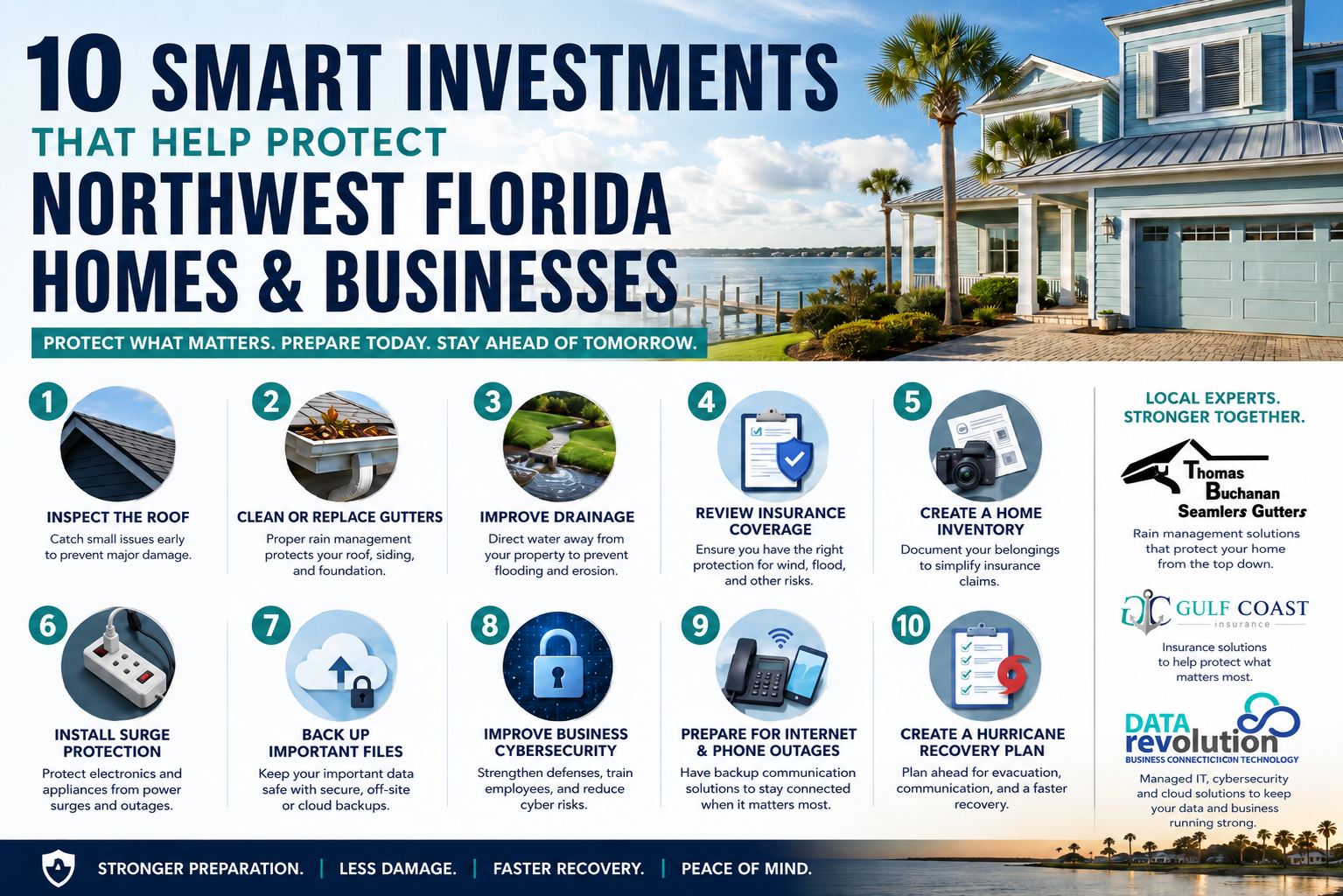
Owning property in Northwest Florida comes with plenty of advantages, including warm weather, coastal access and growing communities. It also comes with unique risks.
Homes and businesses in Pensacola, Navarre, Gulf Breeze, Pace, Milton, Crestview, Destin and surrounding areas may face hurricanes, heavy rain, flooding, humidity, salt air, intense sun, power outages and sudden changes in weather.
Protecting a property is not only about preparing when a storm is already approaching. The smartest investments are often the ones made ahead of time, when there is still time to inspect, repair, organize and plan.
These ten projects can help Northwest Florida homeowners and business owners reduce damage, avoid preventable expenses and recover more quickly when severe weather or unexpected problems occur.
1. Schedule Regular Roof Inspections
The roof is one of the most important parts of any Florida property.
Strong wind, driving rain, heat and sun exposure can gradually weaken shingles, flashing, sealants and roof penetrations. Even a small problem can allow water into the attic, walls or ceilings during a heavy storm.
Property owners should watch for:
- Missing, loose or damaged shingles
- Cracked or deteriorated sealant
- Rusted flashing
- Water stains in the attic or ceiling
- Sagging areas
- Debris collecting in roof valleys
- Damage around vents, chimneys or skylights
A professional roof inspection can identify concerns that may not be visible from the ground. It is especially important to inspect the roof after a major storm and before hurricane season begins.
Addressing minor repairs early may help prevent much larger water-damage claims later.
2. Clean, Repair or Replace the Gutter System
Gutters play a major role in controlling the large amount of rain Northwest Florida can receive.
When gutters are clogged, damaged, undersized or improperly installed, water may overflow near the foundation, damage fascia boards, stain siding or collect around walkways and landscaping.
A dependable gutter system should move water away from the structure efficiently.
Check for:
- Leaves, pine needles and roof debris
- Sagging sections
- Leaking seams
- Loose fasteners
- Rust or corrosion
- Downspouts that drain too close to the building
- Water overflowing during heavy rain
Seamless gutters can reduce the number of joints where leaks may develop. Gutter guards may also help limit debris buildup, although the system should still be inspected periodically.
Thomas Buchanan Seamless Gutters helps property owners throughout the Pensacola area with seamless gutter installation, gutter guards, soffit, fascia and other rain-management improvements.
3. Improve Drainage Around the Property
Gutters are only one part of a complete drainage plan.
Water should move away from the house or building rather than pooling near the foundation, driveway, entrances or landscaping. Standing water can contribute to soil erosion, foundation concerns, moisture intrusion, slippery walkways and mosquito activity.
Walk around the property during or shortly after heavy rain and look for areas where water collects.
Possible improvements may include:
- Extending downspouts
- Correcting low areas in the yard
- Adjusting the slope near the foundation
- Adding channel drains
- Installing catch basins
- Improving driveway drainage
- Adding French drains
- Redirecting water away from entrances and outdoor equipment
Drainage needs can vary significantly from one property to another. A solution that works for a suburban home may not be sufficient for a commercial building, rental property or larger lot.
Thomas Buchanan Seamless Gutters also assists with drainage-related improvements such as French drains and water redirection.
4. Review Wind, Flood and Property Insurance
Insurance should be reviewed before a storm is on the forecast.
Many property owners assume they are fully protected because they have homeowners or commercial property insurance. However, different types of damage may fall under different policies, endorsements or deductibles.
For example, damage caused by wind and damage caused by rising floodwater are generally treated differently. A standard homeowners policy may not cover flooding caused by storm surge, overflowing water or surface water.
Review:
- Homeowners or commercial property coverage
- Flood insurance
- Wind or named-storm deductibles
- Coverage limits
- Roof settlement provisions
- Personal-property or business-property coverage
- Detached structures
- Additional living expenses
- Business interruption coverage
- Equipment breakdown coverage
- Auto, boat or RV policies
It is also important to confirm whether recent renovations, additions, equipment purchases or property-value increases are reflected in the policy.
Gulf Coast Insurance works with homeowners, landlords, drivers and business owners throughout Northwest Florida. As an independent agency, the team can help clients compare options from multiple carriers and identify questions or potential coverage gaps before a loss occurs.
5. Create a Detailed Home or Business Inventory
A property inventory can make the insurance claim process easier after a fire, theft, hurricane or other major loss.
Walk through each room and record the belongings inside. Photograph or video furniture, appliances, electronics, tools, equipment, inventory and other valuable items.
Include:
- Brand names and model numbers
- Serial numbers
- Purchase dates
- Estimated values
- Receipts
- Warranties
- Appraisals
- Photos of the item and its condition
Business owners should document computers, machinery, office equipment, furniture, tools, vehicles and stored inventory.
Do not forget garages, storage rooms, sheds, warehouses and outdoor areas. These spaces often contain valuable property that may be overlooked.
Keep a copy of the inventory somewhere other than the property itself. A cloud-based copy can be especially helpful if paper records or local devices are damaged.
6. Install Surge Protection and Backup Power
Power interruptions and voltage surges can damage electronics, appliances, HVAC components, computers and business equipment.
Basic plug-in surge protectors may provide limited protection for individual devices, but property owners may also want to consider whole-building surge protection installed by a qualified electrician.
Important systems to protect may include:
- Computers
- Routers and network equipment
- Refrigerators and freezers
- HVAC systems
- Security systems
- Point-of-sale equipment
- Medical or office equipment
- Smart-home devices
- Garage door openers
- Entertainment systems
A portable or permanent generator may also help during longer outages. The right solution depends on the property, budget and equipment that needs to remain operational.
Generators must be used safely and never operated inside a garage, home or enclosed space. Property owners should follow manufacturer instructions and local requirements.
7. Back Up Important Files and Business Data
Physical property is not the only thing at risk during a storm or emergency.
Computers, servers and external hard drives can be damaged by water, power surges, theft or equipment failure. Important records may also become inaccessible if employees cannot reach the office.
Homeowners may want to back up:
- Insurance documents
- Property inventories
- Tax records
- Identification documents
- Family photos
- Medical records
- Warranties and receipts
Businesses should protect:
- Customer information
- Accounting records
- Contracts
- Employee files
- Operational documents
- Project files
- Software data
- Compliance records
A strong backup strategy usually includes more than one copy of important files. Cloud-based backups can provide access from another location when a local computer or building is unavailable.
Businesses should also test backups periodically. A backup is only useful if the data can actually be restored.
8. Strengthen Business Cybersecurity
Storm preparation often focuses on buildings and equipment, but cyber risks do not disappear during an emergency.
In fact, criminals may take advantage of confusion, remote work and disrupted routines. Employees may receive fake password-reset messages, fraudulent invoices, emergency-themed phishing emails or requests that appear to come from a manager.
Businesses can reduce risk by investing in:
- Multi-factor authentication
- Strong password policies
- Employee cybersecurity training
- Email filtering
- Antivirus and endpoint protection
- Software updates
- Secure Wi-Fi and network equipment
- Access controls
- Cloud backups
- A written incident-response plan
Remote employees should know how to connect securely and where to report suspicious messages or login activity.
Data Revolution supports Gulf Coast businesses with managed IT services, cybersecurity, cloud backups, network support and proactive system maintenance. Ongoing IT management can help reduce downtime while giving businesses access to technical support when problems arise.
9. Prepare for Internet and Phone Outages
Communication can become difficult during severe weather, especially when power, internet or cellular networks are disrupted.
Businesses should decide in advance how employees, customers, vendors and emergency contacts will communicate if the main office is unavailable.
A communication plan may include:
- Updated employee contact lists
- Alternate phone numbers
- Cloud-based phone systems
- Call forwarding
- Remote voicemail access
- Text-message groups
- Backup internet options
- Portable battery packs
- A designated emergency contact
- A customer-notification process
Cloud-based phone and collaboration systems may allow employees to continue working from other locations when the building is inaccessible.
Businesses should also consider how customers will receive updates about closures, delayed service or reopening. Website notices, email, social media and voicemail messages can all be part of the plan.
Data Revolution also provides VoIP, Microsoft 365 and communications support for businesses that need more flexible ways to stay connected.
10. Create a Written Hurricane and Recovery Plan
A hurricane plan should cover both preparation and recovery.
Waiting until a storm is approaching can lead to rushed decisions, unavailable supplies and confusion about responsibilities.
A written plan should explain:
- Who is responsible for each task
- When shutters or protective materials will be installed
- How outdoor items will be secured
- Where vehicles and equipment will be moved
- How important records will be protected
- When the property will close or evacuate
- How employees or family members will communicate
- Which vendors should be contacted
- How damage will be documented
- How insurance claims will be reported
- What must happen before reopening or returning home
Business plans should also address payroll, remote work, customer communication, vendor disruptions and the order in which critical systems will be restored.
After a storm, photograph damage before beginning temporary repairs when it is safe to do so. Save receipts for emergency work, temporary lodging, equipment or other storm-related expenses.
Review the plan at least once a year and update contact information, insurance details and responsibilities as needed.
Protecting a Property Requires More Than One Solution
No single project can eliminate every risk associated with owning property in Northwest Florida.
The strongest protection usually comes from combining physical maintenance, proper drainage, appropriate insurance, reliable technology and a clear emergency plan.
A well-maintained roof and gutter system can help control rain. Insurance can provide financial protection for covered losses. Data backups and cybersecurity can protect the information a business depends on. A written recovery plan can help everyone respond more calmly when time matters.
Start by identifying the property’s most urgent weaknesses. From there, create a realistic schedule for inspections, repairs, coverage reviews and technology improvements.
The goal is not to prepare for every possible situation perfectly. It is to reduce preventable damage and make recovery easier when Northwest Florida weather puts your property to the test.
